George Cecil Smith was born in Logan, Ohio, on August 13, 1881, on a small farm his father’s parents had been renting. George’s parents were both very young when they were married and didn’t get along well living with his parents. After Effie, his elder sister, and George were born, George and Dora separated and the two children were raised by their Grandmother Ramey.
Later on, his mother remarried to a man named Mr. (Henson) Bright, and they had two children, Sylvia and Charlie.
George was farmed out to a neighbor at age eleven, earned his own way thereafter, and never returned to school after sixth grade. Once, when another farmer about twenty miles away needed extra harvest help, George applied and was hired. The man who hired him was named George Newton Smith, his own father, who had not even recognized or known the new hired hand was his own son. His own father had remarried and had another son, Frank. George’s father had never supported him or shown any concern for him. In later years, George visited his father in Ohio. Outside of similar physical appearances, the two Georges found nothing in common.
George enlisted in the army and served five years. Grandma Ramey signed his enlistment. George served in the Philippines in the army of occupation after the Spanish-American War. Here he contracted malaria and was often bothered by recurring bouts of it later in life.
Back in the States (before he went to the Philippines), he was serving at Fort Assinniboine, in Montana, and was the fort milkman. He met Mary Holo, who was the cook for the family of Army Major Andrews, one of the officers of the fort. Later on, when out of service, and when Mary was back in Minneapolis, the two were married on June 6, 1909, by a Norwegian minister at the home of a friend, in the presence of relatives and friends. Some of the relatives were Mary’s and had emigrated from Norway also.
Mary Holo was born in Skjåk, Gudbrandsdalen, Norway, on October 19, 1880, on a small, rocky, hillside farm owned by her parents, Kristen and Gunhild Holo. Mary had two sisters, Marit and Keia, and one brother, Kristen Jr. Mary helped with the work of the dairy farm and helped take care of the sheep and goats. She helped to spin the wool from the sheep and goats into yarn for home knitting and weaving. In the summer, she helped drive the cattle up the seven long Norwegian miles to the sæter, a place up in the mountains where the cattle pastured on the high meadows. She helped to care for the cattle and made the milk into cheese which had to be carried down the seven mountain miles back home and to town for sale. Mary’s younger sister, Keia, came to America also, but Marit and Kristen remained in Norway until they died. Kristen Holo, Mary’s father, died at the age of 62 about 1918 of heart problems. Gunhild Holo lived to be 94, and died in 1946, after the Germans were driven out of Norway from World War II.
Mary Holo apprenticed herself to be a dressmaker in Christiania, now called Oslo, to earn money for her passage to America. She did careful tailoring and made beautiful, hand-pearled buttonholes, so necessary then for clothing for all ages since clothing was fastened entirely by buttons.
Then she sailed to America on a liner, being two weeks on the liner and seasick all the time on board. She came by way of Montreal and traveled to Appleton, Minnesota, where she lived with a Norwegian family for six weeks while she attended the regular public elementary school to learn the English language. She managed to get through the third grade with six other immigrants. When she reached Appleton, all she had was a twenty-dollar gold piece.
After six weeks of schooling, she took a job with the Mitchell family in St. Paul. The younger son later started the William Mitchell College of Law in St. Paul. She later worked for the Major Andrews family and traveled west with them when Major Andrews was assigned to Fort Assinniboine, Montana. Here she met her future husband, George Smith, who was the milkman for the base.
After their marriage on June 6, 1909, George worked for the Midland Linseed Oil Company for less than two dollars for a twelve-hour day. Later he worked at the roundhouse, helping to repair engines for the Minneapolis and St. Louis Railroad until he retired in October 1953, at the age of 72.
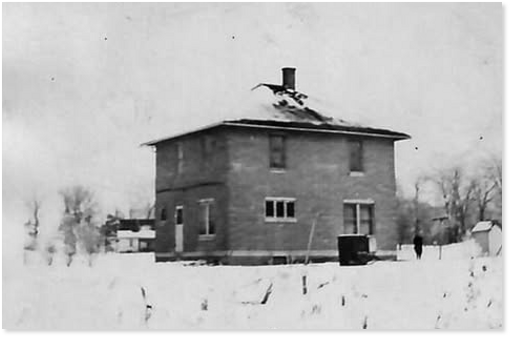
When first married, George and Mary Smith lived in Prospect Park in Minneapolis. They then purchased property in Robbinsdale. George’s mother and stepfather came to Minneapolis and lived in the same apartment building as George and Mary did. Charlie, George’s half-brother, sometimes had to be guided by George since Charlie liked his spirits and became somewhat wild. George once grabbed a gun from Charlie, who seemed bent on self-destruction. George broke the gun apart and disposed of it in the nearest outdoor privy. Later, the Bright family moved back, living first in Missouri , and then in Ohio.
When George and Mary moved to Robbinsdale, they had about twenty acres of land, so they had a dairy cow for milk, raised the calf for meat, and had large gardens from which Mary canned a good share of their winter’s food supply. Later they sold over half the property and house, having built a cement block house in 1922 on the southern half of the property.
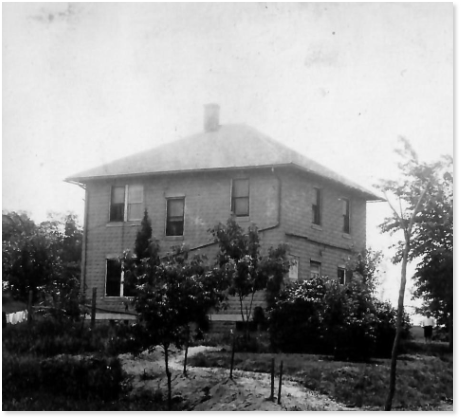
George cut firewood in his spare time to keep the fires going for cooking and heat. They lived in this house until they died. George died on April 20, 1964, and Mary followed on January 18, 1965. Mary said, after almost fifty-five years of married life, there was nothing more to live for when George died. The children were all on their own and independent, and she longed to be with Papa, as we all called him.
Their children and grandchildren had helped them celebrate their Golden Wedding on June 6, 1959, along with many old friends and neighbors. George and Mary had seven children, all of them educated in the Robbinsdale schools. Of the four children married, they had 10 grandchildren.
George and Mary Smith had weathered the severe financial stress of the Depression and still raised their family despite the hard times. Their children and grandchildren have all become independent and live in various parts of the United States. All are useful citizens, helping in their communities.
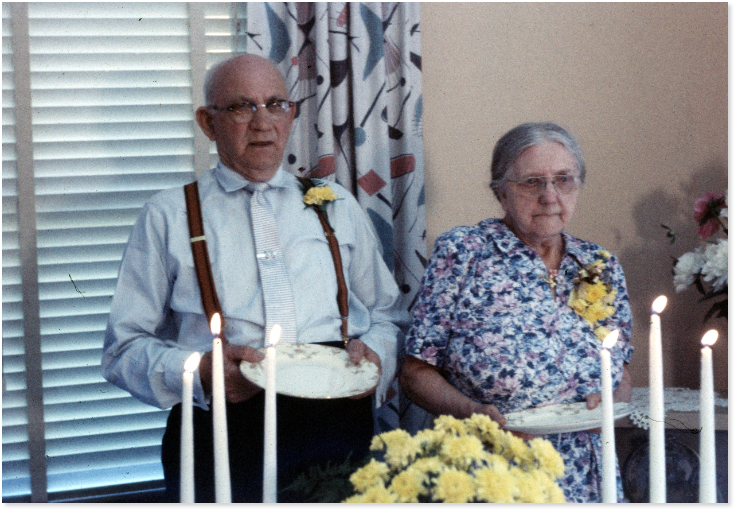
Sheldon Smith grew up living two doors from Grandpa George and Grandma Smith in Robbinsdale, so he saw both Grandparents in his youth. He shared the following memories of Grandpa and Grandma Smith. I grew up two doors down on France Avenue from Grandpa and Grandma Smith. I spent a lot of time in their home as did my siblings Nola and Kirby. Grandpa called me ‘the little professor’ and I was ‘little Bud’ to Grandma. Grandpa loved to watch ‘the westerns’ on TV, classic Gene Autry and Roy Rogers. I was a regular sidekick on his neighborhood walks. During school I’d frequently stop in at their house before going home. There was a well-trodden path through the back yards between our homes.
COMPILED BY CLARA M. SMITH HANSON (Retyped and edited by Rolf Hanson August 2026)
This little excerpt is edited down from a much longer family history you can read by following these links.
3300 France Avenue Land Patent
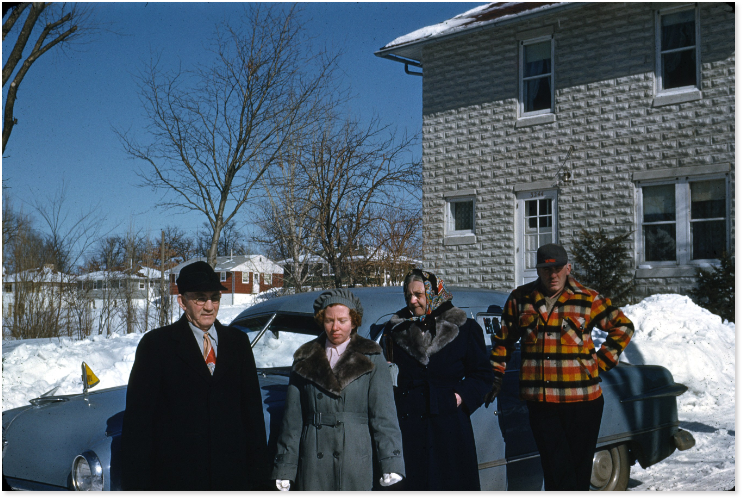
The image at the top of the post is George, Helga, Mary, and Oscar Smith at 3244 France Avenue, mid 1950s