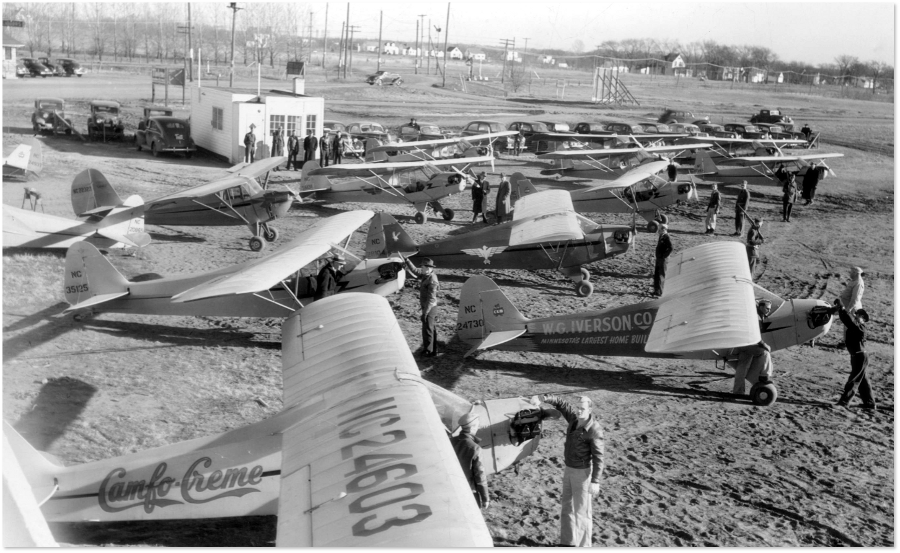
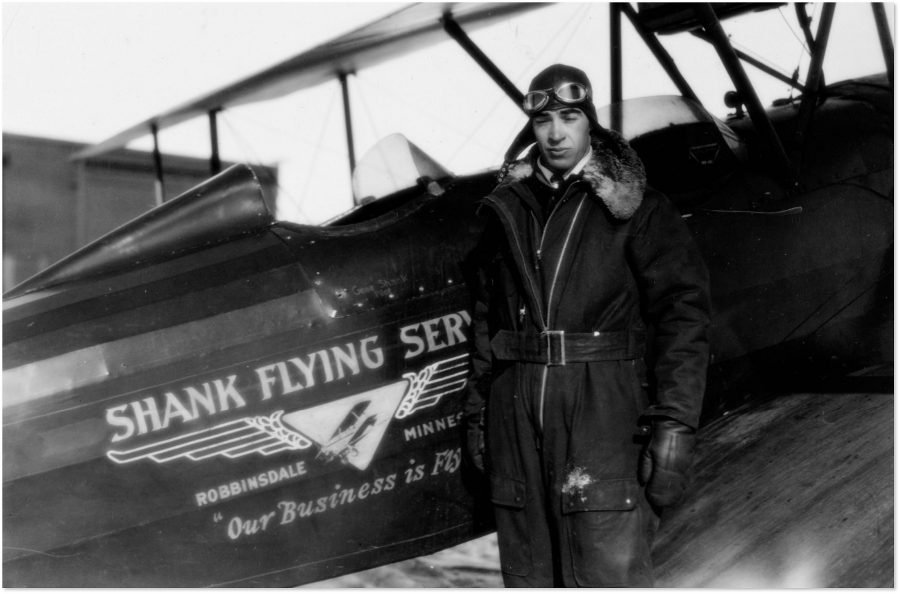
The Robbinsdale Airport operated from 1919 until the end of World War II on land that is now largely Welcome Park and surrounding area. The airport became an important center of early aviation, attracting pioneer pilots, stunt flyers, home-built aircraft enthusiasts, and spectators. Walter Bullock was one of its early leaders, helping establish the airport and flying for Captain Billy Fawcett. Gene Shank tested experimental aircraft and eventually set a world record for 569 consecutive loop-the-loops. Fawcett’s Modern Mechanics magazine further connected Robbinsdale to the growing fascination with building and flying airplanes.
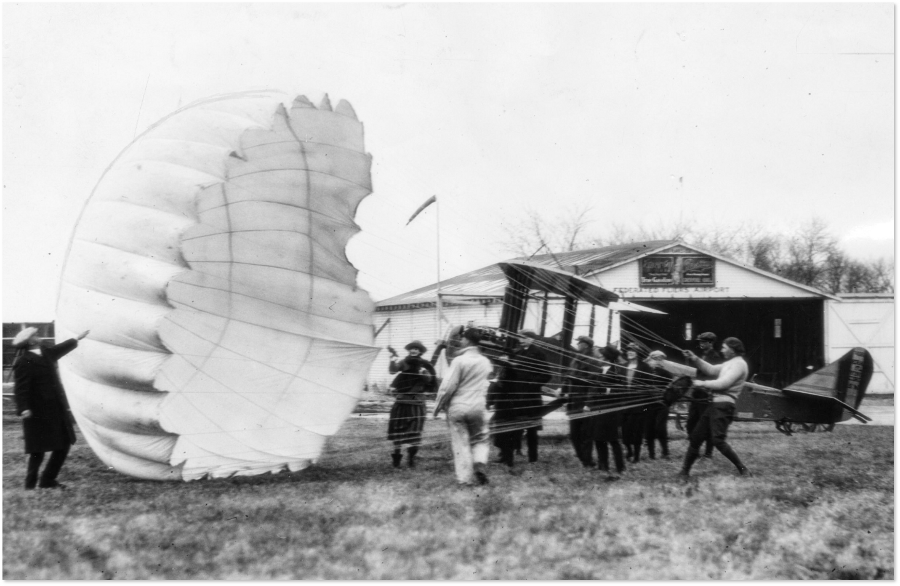
The airport was also home to some remarkably daring women aviators. Gene Du Rand attempted a women’s high-altitude parachuting record in 1929, jumping from more than 19,000 feet in freezing conditions. Frances Clark made a dangerous first jump over Robbinsdale in 1927 and survived only because local fishermen rescued her from Twin Lake. Harriet Frost, a prominent Robbinsdale businesswoman and aviation enthusiast, was killed in a 1937 crash shortly after taking off from the airport. Off the field, aviators gathered at Ellis’s Log Cabin Restaurant and formed the informal Zero-Zero Club. Together, these stories portray Robbinsdale aviation as an adventurous, sometimes dangerous community that attracted people willing to push the limits of early flight.
World War II transformed the airport’s role. Beginning in 1942, Robbinsdale became an important base for the Civil Air Patrol, whose local volunteers, including women pilots, provided their own aircraft, fuel, and time while conducting patrols, reconnaissance, communications, and other defense-related duties. But postwar residential development increasingly surrounded the airport, raising safety concerns. After a 1944 fire destroyed three hangars, the Minnesota Department of Aeronautics refused to re-license the airport in 1945 because of its proximity to homes. The aviation community responded by moving north, where a new 100-acre field became Crystal Airport in 1946. Today, Welcome Park occupies much of the site of the old Robbinsdale Airport, while Crystal Airport continues the aviation tradition that began there more than a century ago.
Listen to the rest of the Story!
Photo at the top of the post Courtesy of Hennepin County Library