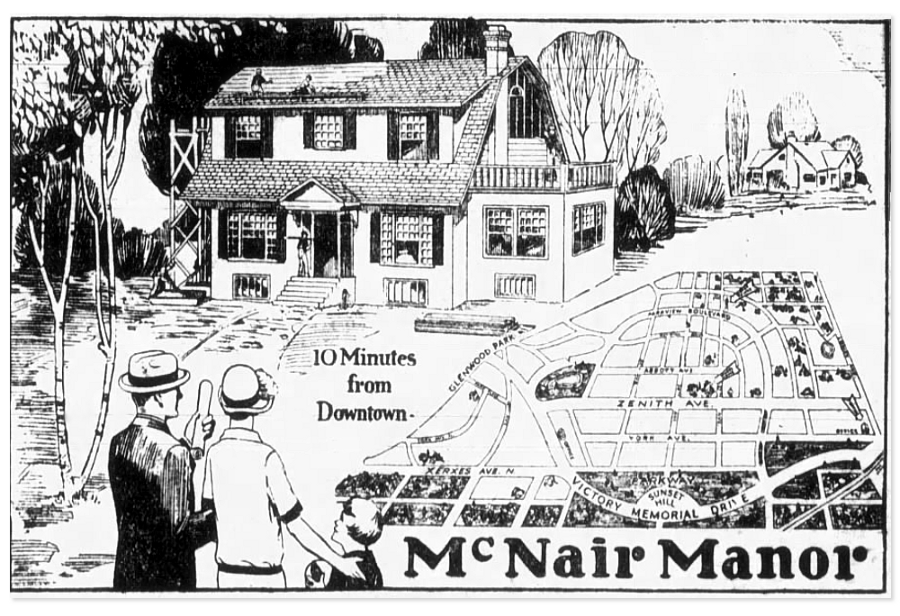
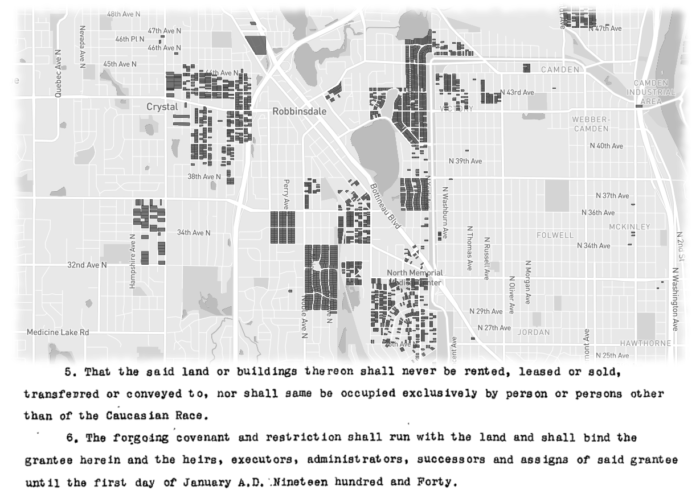
While Andrew B. Robbins began platting and developing subdivisions in the 1890s before racial covenants became common, restrictive clauses began appearing in Robbinsdale around 1915. They became widespread in the 1920s. These covenants were written directly into property deeds and prohibited homes from being sold, rented, or occupied by people who were not white. Developers sometimes promoted these restrictions through coded advertising such as “wisely restricted” or “reasonable building restrictions,” effectively using racial exclusion as a marketing tool. Although Minnesota outlawed racial covenants in 1953, the language remains in many deeds today. The Mapping Prejudice Project has helped document their widespread use, while the Just Deeds Project helps homeowners remove the obsolete language from their property records.

In subdivisions as wide spread as Glenwood Manor, Robbinsdale Home Gardens, Crystal Lake Heights, McNair Manor, Sanborn Terrace, Victory View, and Snyder’s Victory Memorial Drive, real estate companies aggressively marketed developments by emphasizing streetcar access, proximity to Minneapolis, affordable lots, gardens, parks, and attractive homes, while the deeds imposed racial restrictions. The Sanborn subdivisions were particularly striking, with covenants explicitly excluding people of Chinese, Japanese, Moorish, Turkish, Negro, Mongoloid, or African descent. This has led to some discussion as to whether a public space should continue to bear the name of people whose development practices helped create a whites-only neighborhood. The broader question becomes how communities should remember people whose legacies contain both historical accomplishments and deeply discriminatory practices.
Listen to the rest of the story.
The impacts of these policies lasted far beyond the years when the covenants were legally enforceable. The racial makeup of Robbinsdale remained overwhelmingly white for decades, and discriminatory practices continued even after 1953, as illustrated by the experience of the Wright family in nearby Crystal and by accounts from people of color who struggled to buy or rent homes in the West Metro. The discussion also places Robbinsdale’s history in the context of the Ku Klux Klan’s activity in the area during the 1920s and the continuing effects of segregation visible in later decades. The Mapping Prejudice Project, Just Deeds, and community historical research offer ways to confront that history, learn from it, and consider how Robbinsdale should remember and represent its past.
The Robbinsdale Historical Society and Robbinsdale Human Rights Commission are committed to researching and sharing the history of racial covenants and their impact on our community. Resources are available to promote a greater understanding and build networks of people who wish to get involved and address how racial covenants impact our cities today.
And if these exclusions were outlawed in 1953, is there any validity to these deeds. It is good to bring forward this discriminatory past. It horrifies me as a proud resident of Robbinsdale and graduate of the Robbinsdale Jr and Sr high. Now live in multicultural Hawaii. Thankfully laws have changed. But let us strive to learn from the past and strive even harder to be one people, one United States of America.
Racial covenants are no longer enforceable in Minnesota due to changes in law, but they may still appear on property deeds. They can be discharged and disavowed by current property owners and there are organizations like Just Deeds that can help guide people through the process.