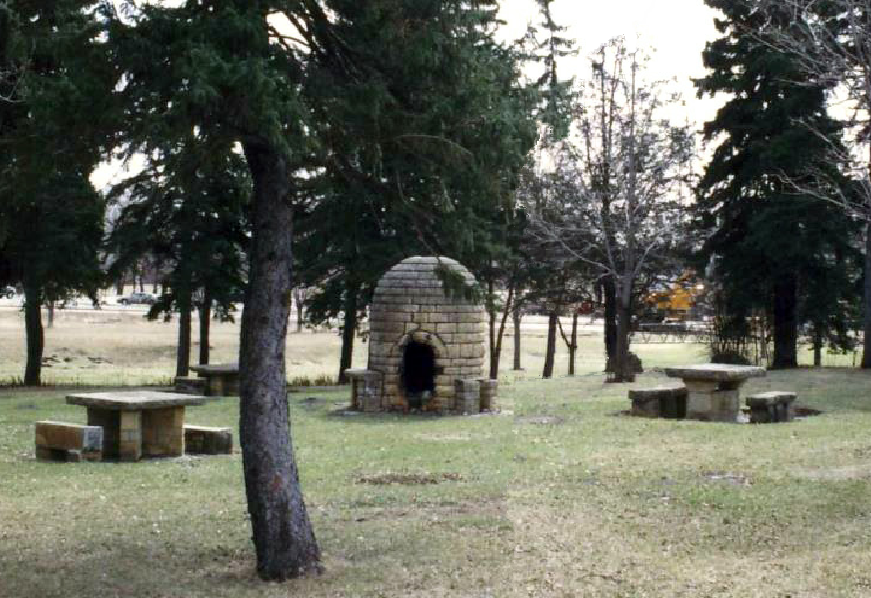
Constructed in 1940-41, the park was first called the “Robbinsdale Rock Garden Roadside Parking Area,” in keeping with the six other “Lilac Way” parks built along Highway 100. It was soon renamed “Graeser Park” to honor retired highway engineer Carl F. Graeser, known as the Father of the Belt Line. In his later years he bought a home on Unity Avenue in Robbinsdale, near the park.
Graeser Park was the largest, most elaborate, and last of the Lilac Way parks along Highway 100 between Highway 52 and the old Jefferson Highway (now West Broadway).
In addition to a picThe park’s enchanting rock garden and beehive-shaped fireplace, from tan limestone with a domed top and three brick-lined fire boxes. , flanked by benches. Robbinsdale’s beehive, is the only one in the entire US still in its original location.
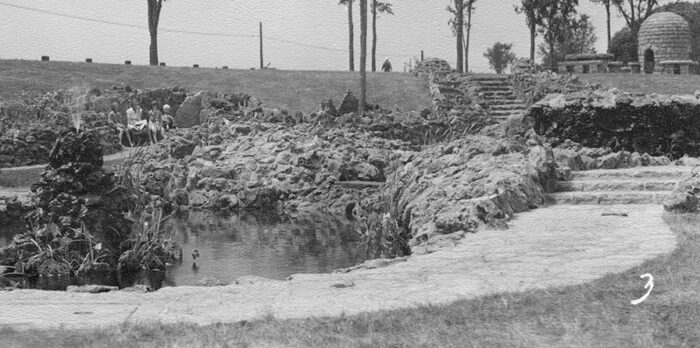
In addition to the unique beehive and the enchanting rock garden, other original structures that have survived include a large, semicircular limestone terrace. It was designed as an “overlook,” because it provided a lovely view of the new scenic highway. Also remaining is the low entry wall with steps down to the picnic area, and the original stone curbing along Lakeland Avenue.
There was originally a stone culvert that diverted rainwater, a stone drinking fountain, a circular stone barrel for burning trash. These, and the park entry sign and a stone stairway from West Broadway have been lost.
In its heyday, Graeser Park was a favorite spot for family picnics and reunions, scout meetings, school outings, and gatherings of friends and relatives. The nineteen stone tables of various sizes, five barbecue grills, and the beehive fireplace accommodated groups of all sizes.
Graeser was a popular rest stop for travelers along the Belt Line, but also for motorists making their way along old Jefferson Highway (a north-south running right through downtown Robbinsdale on its way from Winnipeg to New Orleans).
Some of Graeser Park’s original features have stood the test of time, such as the towering pines planted eighty years ago. But in the years since 1940, the park’s stone structures and limestone paths began to crumble, tables were removed, weeds overtook the rock garden, and the water supply was disconnected. The park was neglected and mostly forgotten until 2008, when volunteers from the Robbinsdale Lions Club started to care for the rock garden, cleaning paths, cutting down overgrowth, and pulling weeds to keep the park visible until preservation work could begin.
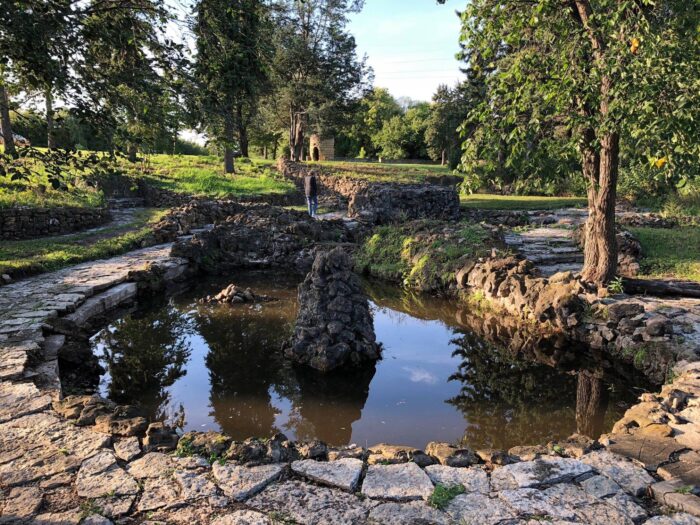
FAST FORWARD to 2020

The Lions’ stewardship of the rock garden drew the attention of MnDOT’s Historic Roadside Property Program for management, protection, and preservation of properties with historic features along the state’s transportation corridors. Program manager Andrea Weber, noting the number of original structures still intact, initiated a preservation project at Graeser Park in 2020.
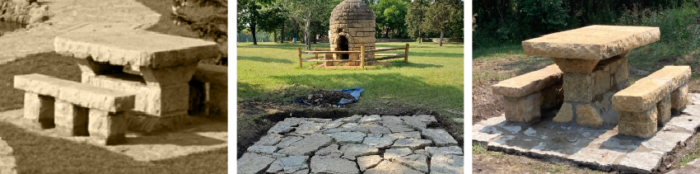
The three-year project was designed to preserve existing structures with stabilization/repair, improve safety and accessibility, and restore original picnic tables that were removed during Highway 100 expansion (late 1990s) and West Broadway bridge reconstruction (2004).
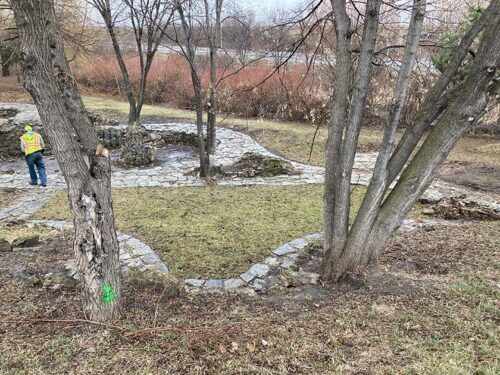
The first step was completed in fall of 2020 with the removal of trees that were threatening some of the stone structures.
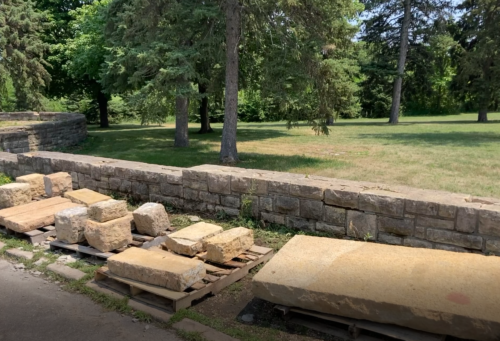
In July 2021, salvaged tabletops and stone pieces that had been removed from Graeser and demolished Lilac Way parks were reused at Graeser to rebuild three table pads and one picnic table near the rock garden.
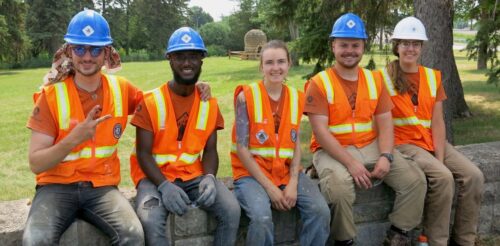
This first reconstruction work was done by Northern Bedrock Historic Preservation Corps, an AmeriCorps program that employs young adults who are interested in learning the preservation trades. Under the supervision of a local skilled mason, the corps members worked hard, even in rain and oppressive heat. They can be proud of what they accomplished in less than a week.
The project’s first phase under MnDOT’s Historic Roadside Property Program was reconstructing more picnic tables, with work done by Environmental Associates Inc. (EAI), the masonry contractor that won the bid for the MnDOT project. EAI is approved by the Minnesota Historical Society for preservation work, and the entire project was designed to meet national standards for historic preservation.
The image featured at the top of this post shows Graeser Park in 2004, before the last of the picnic tables were removed due to reconstruction of the West Broadway bridge over Highway 100.