ROBBINSDALE GROWS WHILE WAITING FOR REINCORPORATION
Making Big Strides Despite Handicap—Becoming One of Important Communities
TAX RATE IS CUT AS IMPROVEMENTS GO IN
Robbinsdale, a residential suburb bordering the northwest city limits of Minneapolis on the Jefferson Highway, is a Minnesota village that is “all dressed up but is afraid to go anywhere.” This community was incorporated as a village in April 1893. A few years ago, the law under which the incorporation was made was repealed. Since that time Robbinsdale has been improvising, waiting for a reincorporation. In the face of this handicap, the village has made wonderful strides during the last five years and is said to be one of the fastest, if not the fastest growing suburban communities of Minneapolis. Alfred B. Parker homesteaded the land on which Robbinsdale now stands, and the community was first known as Parker. Robbinsdale was named after Andrew Robbins, who purchased a large tract of land in 1890 where the village now stands and expended a considerable amount of time and money in its development. He also built the first railway to the town and was instrumental in making many other improvements. Andrew Robbins built a home near Twin Lakes that is still occupied by his widow, Adelaide J. Robbins, and their daughters Mrs. Edith Robbins Daniel and Mrs. Amy A. Robbins Ware, who remain active in village affairs. Mr. Robbins died in 1910. He was a prominent Minnesota pioneer, arriving in 1855. He served in the Civil War, built a sawmill at Anoka, worked for the Great Northern Railway (then St. Paul and Pacific), engaged in business at Willmar, served as state senator and representative, fought the grasshopper plague, and later developed Robbinsdale through real estate work. L. I. Nassett was the first postmaster.
Most of the growth of Robbinsdale has been in the last five years. In 1920 the United States census showed a population of 1,369 persons. Estimates now place the figure at more than 6,000, with population still increasing rapidly. Actual value of real and personal property in this district is $5,000,000, compared with $3,000,000 two years ago.
Tax Rate Cut to 79 Mills
Residents of Robbinsdale are proud of progressive business administration in village and school affairs, which has reduced taxes while allowing extensive improvements.Tax rates show a reduction from 120 mills in 1925 to 79 mills in 1926. The recent construction of the Sacred Heart parochial school is said to have contributed by reducing expense and overhead of public schools. For 1926, village taxes are 20 mills; schools, 35 mills; state and county, 13 mills; and general purposes, 1 mill. This tax reduction means that a residence property assessed at $1,000 has had its tax payment reduced by $40.
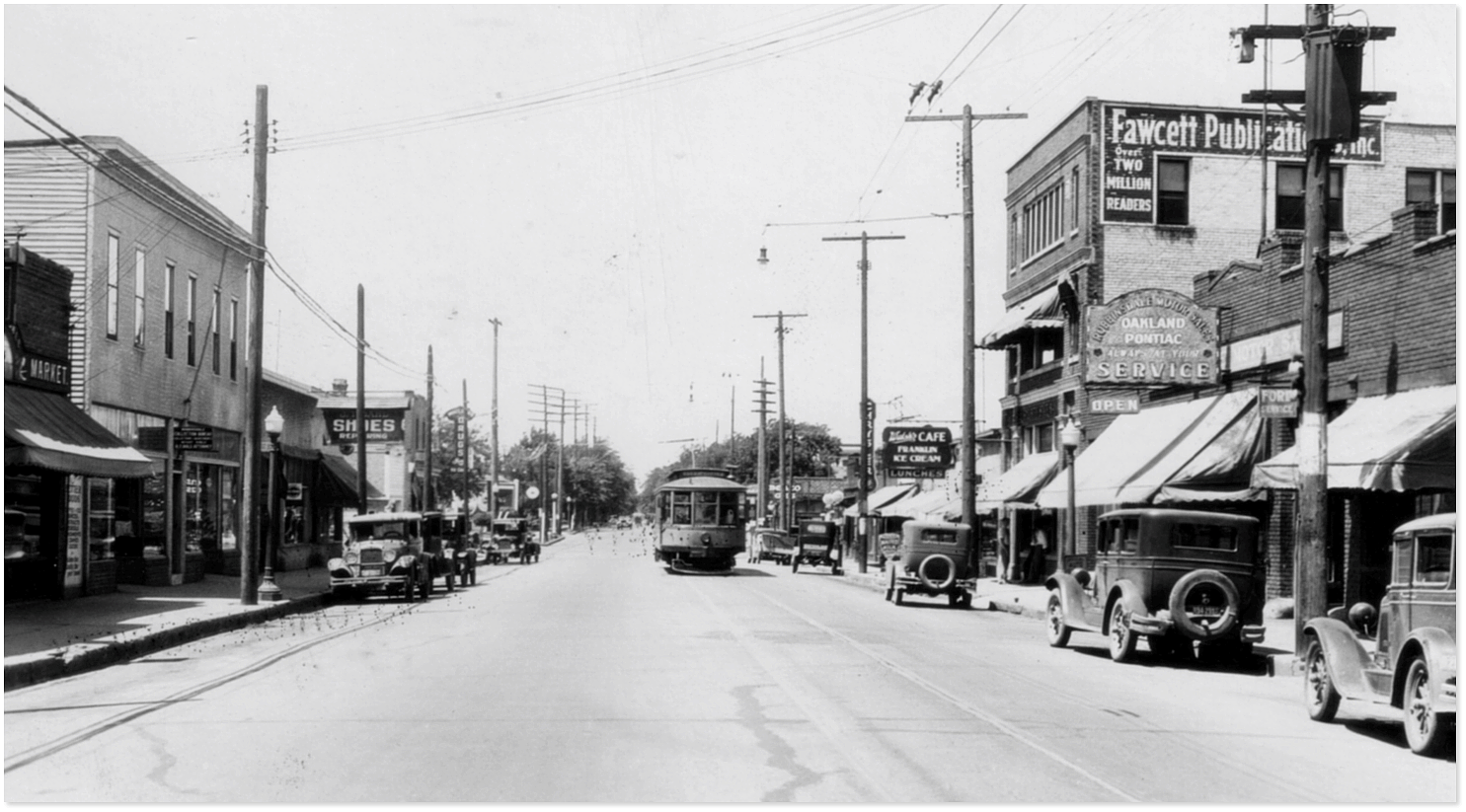
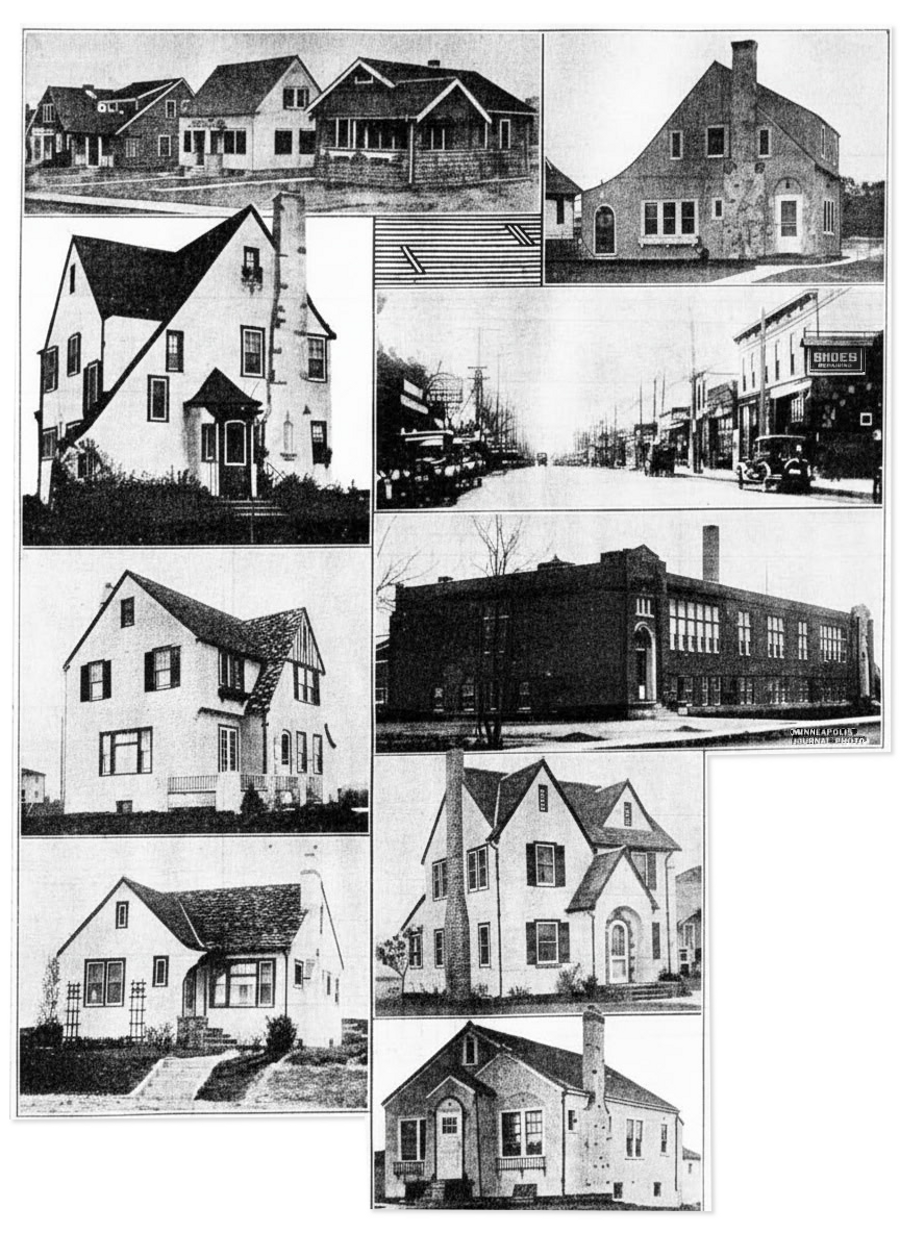
Two years ago, a large part of the main street of Robbinsdale was destroyed by fire. This proved fortunate for the village, as every burned building was replaced with a much better structure. A total of $250,000 was spent for new business blocks in 1925, followed by $60,000 in additional improvements this year. From end to end, the street now has the appearance of being entirely new.
The village is distinctly residential, with no factories or large industries within its limits. It has 30 modern retail stores, garages, a bank, and numerous oil stations. In 1925, 250 modern homes were constructed, and more than 100 have already been built this year. Construction for the two years will exceed $1,000,000. A bi-monthly paper, the Northern Headlight, is published here.
Lakes, Homes, and Institutions
Within the village limits, covering two and a half square miles, are Crystal Lake and part of Twin Lakes. Many summer homes and year-round residences are located on these lakes. Religious institutions include Congregational, Catholic, German Lutheran, and Swedish Lutheran churches. Emaus Mission also has a building in the village.One large public school containing a junior high operates in Robbinsdale; a $200,000 addition has recently been completed. Two portable school buildings are also included in the system. Sacred Heart Catholic parochial school was completed this summer at a cost of $50,000, through the efforts of Father Blum. The school board is proud of reducing the tax rate for school purposes without reducing teacher salaries or limiting facilities.
School board members include:
B. E. Arntsen, chairman
Mrs. Edith Daniels, clerk
L. P. Hyde, treasurer
C. W. Lorenz
Flora O. Wandel
Penn Knowles
This year, 17½ miles of water mains costing $200,000 have been laid. Negotiations with a public utility company are expected to result in gas installation in 1927. Water is purchased from the Minneapolis water department. New fire-fighting equipment has been added, reducing fire insurance rates. The village has a volunteer fire department with 24 members. Chief is George J. Kuch; first assistant is Warren Bartlett. There are two bands: the Robbinsdale Concert Band, led by W. F. Grenell, and the South Town Community Band, led by L. L. Spotten.
Continued Growth and Civic Life
In five years Robbinsdale has grown from a small suburb to a modern village of about 5,000 people with a distinctly metropolitan air. In the last two years, 350 homes have been built, the main street has been entirely reconstructed, and many other improvements completed.
Possible City Government Changes
A committee is working on reincorporation, and it is expected that Robbinsdale may soon become a fourth-class city under Minnesota law, possibly adopting a city manager form of government.
At present, the village is governed by a council assisted by a manager.
Council president: Harvey A. Morse
Clerk: Herbert Clasen
Treasurer: Herman Renspies
Council members: Clyde F. Burfeind, Ralph F. Peterson, R. J. Gladwin
Village assessor: Robert Hansen
Village manager: Clinton F. Wilson
Justices of the peace: John B. Grones, Charles H. Hubbell
Motorcycle policemen: William Ham Schlund, George J. Kuch
Closing Civic Notes
A proposition to join Robbinsdale with Minneapolis was defeated by voters in recent years.
Robbinsdale continues growing while waiting for reincorporation, with strong civic organizations, including:
Robbinsdale Business Men’s Association (30 members)
Robbinsdale Commercial Club (76 members)
South Town Community Club
The village has a system of parks under development, particularly around Crystal Lake and Twin Lakes. A $10,000 public library building was completed this summer through the efforts of the Ladies’ Library Club in affiliation with Hennepin County Library. The Library Club of Robbinsdale has large facilities. Margaret Stillman is chairman of the board of directors.
Good transportation includes 20-minute streetcar service to Minneapolis and Great Northern railroad access.
THE MINNEAPOLIS JOURNAL- Sunday, October 24, 1926